Posts

Showing posts with the label science

Subjects I Studied at GCSE & A-level
Image
Subjects I Studied at GCSE & A-Level I'm often asked on my Instagram ( @astudentofbms ) what subjects I studied at GCSEs and A-Level, because people like to know what opportunities they can have after completing GCSEs and A-Levels.  I didn't know what I wanted to do as a career, so I tried to pick GCSEs and A-Levels that gave me a wide range of options later on.  I did my GCSEs in 2018, and then my A-Levels in 2020. I didn't actually manage to finish my A-Levels, because of COVID, and I wasn't able to sit my exams, so I was a bit worried what results I was going to get. All that doesn't matter now though, because I got accepted onto my degree, and now GCSEs and A-Levels are a thing of the past. 📖 GCSEs As with most schools, I had to study: 📚 English Language + Literature Maths + Maths Numeracy Sciences - Biology, Physics + Chemistry And then, because I'm in Wales, I studied: 📚 Welsh Language + Literature Welsh Baccalaureate For my optional GCSEs, I was ab...
How I Have a Productive Day!

Image
How I Have A Productive Day Productivity is something I can really struggle with, especially if I don't have a good start to my day. In today's society, there's a lot of focus and pressure on being productive 24/7. There's this mindset that you have to be doing something productive with your time, everyday, all day, otherwise you've wasted time or are failing. I am guilty of feeling this mindset a little to often. Even when I've finished all exams and assignments, I'm constantly looking for the next productive thing to do - even if there is literally nothing to do! I find myself Googling; 'Productive things to do when bored', and I'm always reading posts on staying productivity. It can be quite a damaging mindset to have.  However, I have made this post, not to make people feel guilty about not being 100% productive, nor to tell people that you need to do these steps everyday. I am simply trying to show you the ways I remain productive, and hopef...

Year 1 Semester 2 Modules

Image
Year 1 Semester 2 Modules This post is to recap my semester 2 modules. I really enjoyed my second semester, and I am so glad that I've now completed my first year! Although not what I expected my first year of university to be like, I did find it enjoyable, overall. I didn't have as much lab time as I'd hoped, and I haven't really met any coursemates, but it's not been too bad. I am looking forward to next semester! For now though, I'll give you some information on my first semester's modules, but in particularly my second semester. 4104 - Introduction to Biomedical Science ðŸ”¬ I really enjoyed this module, I think because of the variation in content and assessments. This unit focused on the work of biomedical scientists, such as the diseases they can help diagnose, how they do this, and the procedures in different NHS laboratories. I found this extremely interesting, because this is what I want to do in the future - work in an NHS lab - so I was glad that we...

How I Study As A Biomedical Science Student

Image
 How I Study As A Biomedical Science Student The one thing I was quite apprehensive about before starting my course were the type of assessments I'd get and if I'd be able to study for them properly. I had completed my GCSEs and done well in those and had completed my AS levels and done fairly well in them too - but I'd never got the chance to do A Level exams. I had been studying consistently throughout the year in preparation for the exams, but they never happened, so I was nervous because I wasn't sure how effective my studying methods were. When the time did come for me to have my exams, I wasn't actually that worried - because they were all open-book due to COVID! This meant that I had to do the exams from my laptop at home and was allowed to look at my notes whilst completing the exam. I feel that this was a blessing but also a curse, because on the one hand it meant that I'd probably get good results because I had the answers right there in front of me, b...

Year 1 Semester 1: Lab Sessions Recap

Image
Biomedical Science Year 1 Semester 1: Lab Sessions Recap Labs are definitely something I was worried about before starting my course. I hadn't been able to complete my practical exam for Biology A-level (due to COVID) and had never even been in a lab before, so I was nervous that I'd be out of my depth. Fortunately, that is the first thing that was addressed in my first lab session! The tutors suspected that most people hadn't been in a lab before, so we were all taught the basics. This made sure that everyone was on the same page and had basic knowledge of labs, even if they'd never been in one before. It was very helpful, as now I didn't feel as unprepared. I had been able to see pictures of the lab off my university's website before I went there, but I was never able to go there in person. I had planned to, but because of coronavirus, all the open days had been cancelled. This post is just giving you an insight into what my lab sessions were for the first sem...

My First Semester Recap!

Image
A Recap of My First Semester Studying Biomedical Science

Year 1 - Semester 1: Assignments

Image
Biomedical Science Degree Year 1 Semester 1 Assignments This post is just some information about the different assignments I did in year 1, semester 1. #biomedical science #BMS # biomed #student #uni #university #biology #science #biomedical #bio #medical #studentofbiomedicalscience #adayinthelife #careers #school #learning #assignments #exams #preparation

Year 1: Semester 1 Modules

Image
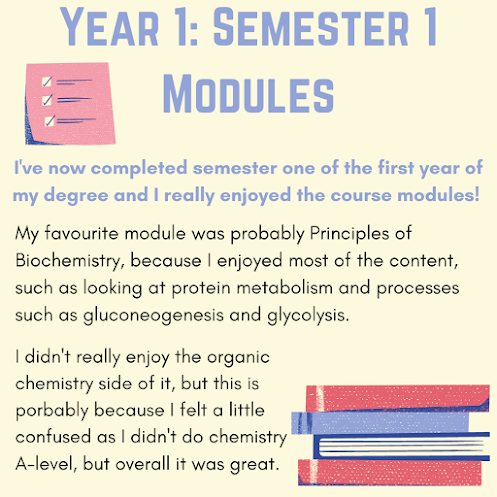
Biomedical Science Degree Year 1 Semester 1 Modules  This is just a little post to talk about the content I studied in my first year and how I found it. The content and modules for each university is different in how it's taught/assessed and the actual names of the modules, but the same type of basics are covered in year 1. 

My Degree Modules

Image
Biomedical Science Degree My Modules Here's an infographic showing the modules I will be studying during my degree. Courses do vary from uni. to uni. but the overall content is generally the same. Biomedical science is quite a broad subject which I enjoy, as it allows you to learn about a whole range of different areas. I've only just completed Semester 1 of year 1, so the only modules I've done so far are cell biology, biomedical skills and principles of biochemistry. I will go into a bit more detail about what each individual module involves in another post. 

What Are the IBMS and HCPC?

Image
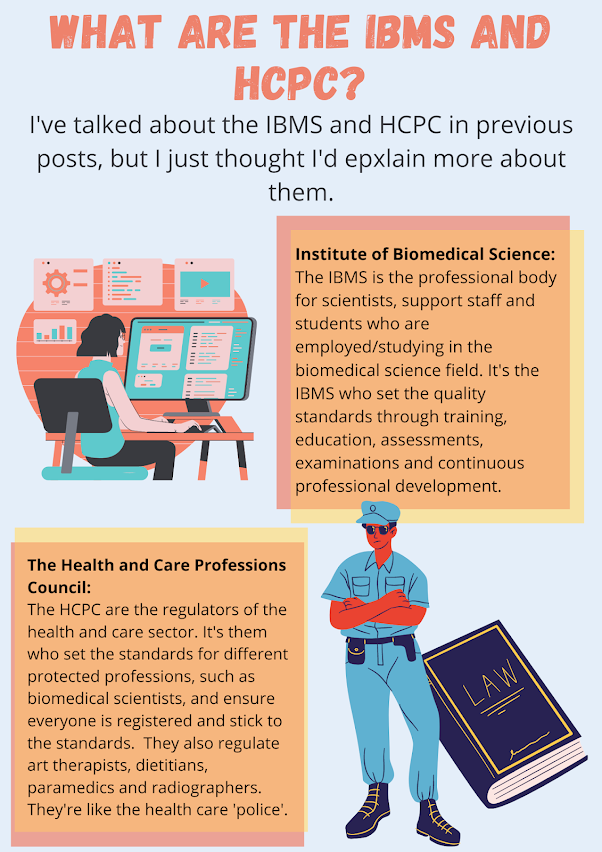
Biomedical Science Degree  What are the IBMS and HCPC? LINKS: https://www.ibms.org/home/ https://www.hcpc-uk.org/

The Route to Becoming a Registered Biomedical Scientist

Image
Biomedical Science Degree - The Route to Becoming a Registered BMS I hope this is clear to everyone that comes across my blog, but I myself am not a registered BMS (biomedical scientist). I aim to be one day, but for now I am just half-way through the first year of my BSc degree.  To become a registered biomedical science, there are quite a few steps you need to take. You need to register with the IBMS, complete training and a portfolio and become registered with the HCPC and so on... At the moment, my future plan looks very similar to the steps I've outlined in the first infographic. However, I'm very keen on trying to get onto the Applied degree route (I'll go into more detail about the different degrees in another pot, but here's just a little information.) If you were to do the Applied route, you would do your first year as a normal degree, but for your second and third years, you would work in a lab and complete the IBMS portfolio whilst studying. This, essentially...

What is Biomedical Science?

Biomedical Science Degree - What is biomedical science? What is biomedical science? Biomedical science involves studying and understanding the causes, diagnoses, effects and treatments of illnesses and diseases - basically. A person who has studied biomedical science and has become registered with the IBMS and HCPC (I will go into more detail about these two organisations in later posts) is known as a biomedical scientist. This person's job is to carry out different tests on a range of patient samples, such as blood, urine and tissues, and to investigate any medical conditions. If you go to your doctor or hospital and they take your blood for testing, it's probably a biomedical scientist who will take that sample and see if there is anything 'wrong' with your blood.  The types of diseases a biomedical science will investigate include: Diabetes Anaemia  AIDS Cancer Viruses  During this pandemic, it's biomedical scientists who have played a vital role in looking at an...

Applying for the Degree

Image
Biomedical Science Degree - Applying for the Degree If you're now wondering how I managed to get onto my course, read ahead, as I'll be talking about the steps I took from GCSEs all the way to September 2020, when I started my degree. So, GCSEs. At 16, I had just completed my GCSEs and had no idea on what I wanted to do next. I was originally not looking to do A-levels, and was trying to find an apprenticeship or some kind of work opportunity, but I just had no idea what type of field or route I wanted to go down. I had interests in a range of fields; science, health, environmental, administrative and legal. I'd looked for apprenticeships everywhere and had emailed a hundred companies, but there were just no opportunities for me in the area I lived. I spoke to the careers advisor at school -which was no help at all! - so I just winged it.  I chose to stay on and do my A-levels, because I had nothing else to do. I'd just gotten a new job at this time, so that was honestl...